
How many AI agent frameworks are there? The honest answer depends on how you count. The LocalAIAgents dataset lists 548 rows, but one project, AutoGPT.js, sits in the table twice under two slightly different IDs. Counted as distinct projects, the dataset holds 547 frameworks, every one recorded at a single snapshot: September 14, 2026. This post counts what that snapshot says about which of them are still alive.
The survival count: 367 inside the window
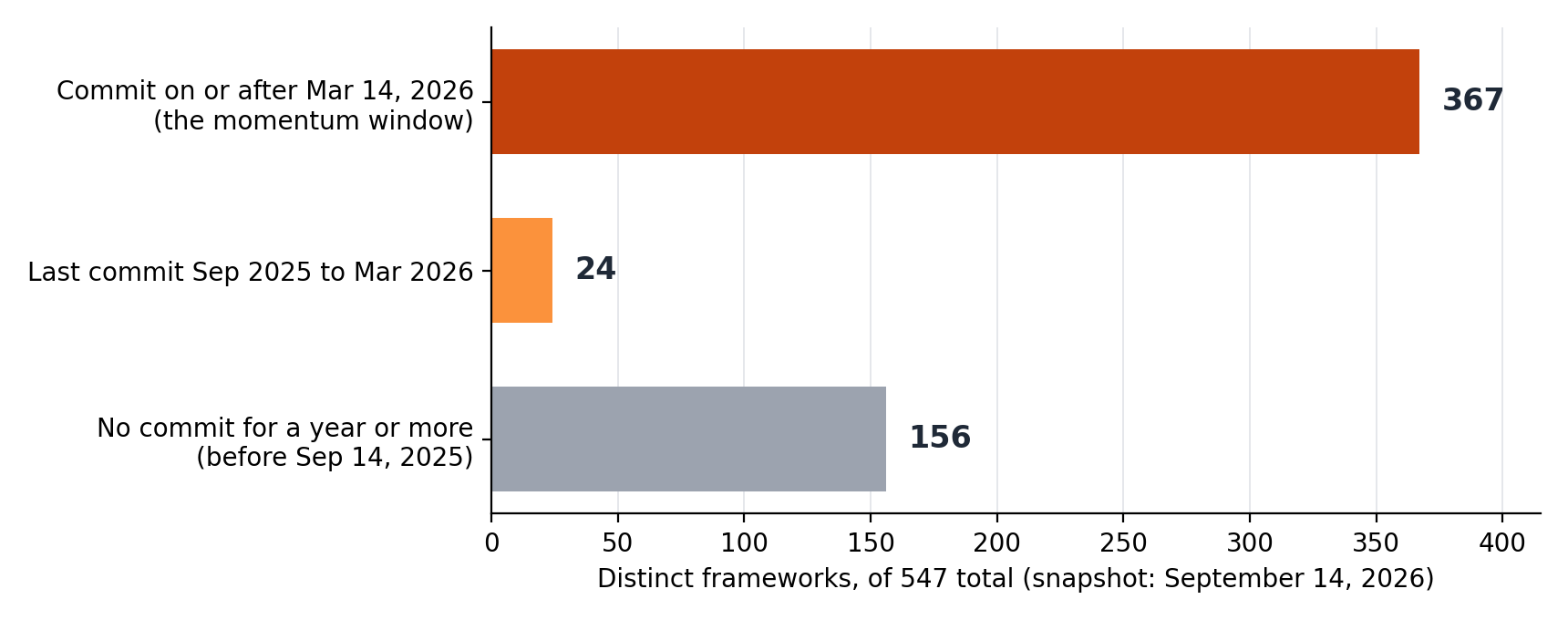
We call a framework still shipping if its repository recorded a commit on or after March 14, 2026. That date is not arbitrary. It is the momentum cutoff FrameworkPicker applies when you answer "actively maintained only", six months before the newest commit in the dataset. By that rule, 367 of the 547 frameworks, 67 percent, were still shipping at the snapshot. The newest recorded commit in the whole table is dated September 14, 2026 itself, so the window is measured against a field that was still moving on capture day. Two picks a day are free in the picker, and its momentum question applies this exact cutoff before any ranking happens.
The silent tail: 156 quiet for a year
At the other end, 156 frameworks, 29 percent, had gone a full year without a commit when the snapshot was taken: nothing recorded since before September 14, 2025. Inside that tail, 119 had been silent since before 2025. A further 24 sit between the two lines, last touched between September 2025 and March 2026: outside the momentum window, but not yet a year quiet. Quiet is not the same as dead. A small, finished library can sit untouched for years and still work exactly as documented, and a one-maintainer project may simply be complete. Read the tail as maintenance risk to price in, not as 156 obituaries.
Who is still shipping
The survivors skew Python. Of the 367 inside the window, 159 are Python projects and 121 are TypeScript or JavaScript, with Rust (20) and Go (19) behind them and the rest spread across a long tail of languages. The license picture is calmer than the activity picture: across all 547 frameworks, 420, or 77 percent, carry MIT (255) or Apache 2.0 (165). Whatever else the field is doing, it is mostly building on permissive licenses.
Why the last commit beats the star count
Stars only move one way. A repository keeps every star it ever earned, so a star table is a history of attention, not a health check. The snapshot makes the gap concrete: GPT Engineer recorded 55,099 stars at September 14, 2026, and its last recorded commit is November 17, 2024, deep inside the silent tail. It is not alone: 10 frameworks with at least 10,000 recorded stars had been quiet for a year or more. The medians tell the same story in aggregate. The typical still-shipping framework recorded 6,980 stars; the typical year-silent one recorded 932. Attention and upkeep correlate, but they are not the same variable.
The screen has limits in the other direction too. AutoGen passes it: Microsoft's framework recorded a last commit of April 6, 2026, comfortably inside the window. Yet Microsoft has since put AutoGen into maintenance mode while it converges on the Microsoft Agent Framework, a fact no commit date can tell you. A recent commit gets a framework onto your shortlist; it does not keep it there. One data footnote: the dataset records AutoGen's license as CC BY 4.0, which is the license on its documentation. The code itself is MIT.
How we counted
Every number above comes from one pass over the dataset's last commit dates across the 547 distinct projects, deduplicated by GitHub URL. Snapshot date: September 14, 2026, the verification date on every row and the newest commit the table records. Momentum window: commits on or after March 14, 2026, the same cutoff FrameworkPicker uses. Two recorded fields were deliberately left out. Contributor counts exist for only 16 of the 548 rows, far too sparse to rank or average anything. An adoption score is recorded in the dataset, but it is not exposed by the data feed the picker runs on, so this census does not use it either. The capability tags in the dataset are raw GitHub topics: useful for matching a job to a framework, too noisy for finer claims, so none are made here.
For the stars view of the same table, start with our most starred repos post. For the table itself, how to read 548 rows is the methods companion, and our adoption trends post reads the same activity data as a story about where the field is heading. This post just counts who is still in it. To apply the census to your own shortlist, run the momentum question in FrameworkPicker.