
Run an AI agent framework comparison database search on the three names everyone argues about, and the argument changes shape. The database rows, captured on September 14, 2026, read like this: AutoGen leads on raw attention with 60,981 stars and 9,207 forks, CrewAI is close behind at 58,535 stars and 8,446 forks, and LangGraph trails at 41,626 stars and 7,032 forks. Then the rows flatten the contest: all three are Python, and all three carry a perfect adoption score of 100 in our scoring. The honest verdict starts there, not with the star gap.
One column cannot help. The database records contributor counts for only 16 of its 547 frameworks, and none of these three is among them, so contributor depth settles nothing here. Anyone quoting it for this comparison is inventing precision the data does not have.
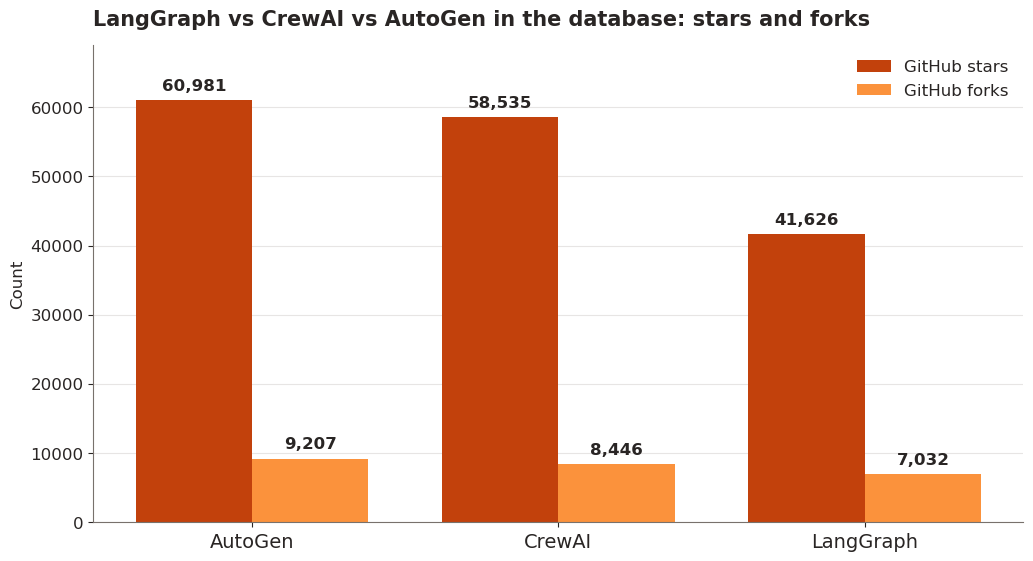
What the rows say, one framework at a time
LangGraph (LangChain Inc.) is the graph and state machine entry: explicit state, replayable runs, and built in checkpointing for human in the loop steps. Its row is fresh, with a last recorded commit of September 9, 2026, five days before the snapshot. The learning curve is the steepest of the three, and the database cannot show that, but the maintenance signal is unambiguous.
CrewAI (CrewAI Inc.) builds role based crews and gets a working demo in front of people in hours. Its row is the freshest of the three: a last recorded commit on September 14, 2026, the snapshot day itself. The gap between its star count and AutoGen's is about 2,400 stars, well inside the noise for projects of this size.

AutoGen (Microsoft) is the conversational, research friendly entry, strong on code generation patterns. Its row carries two caveats the others do not: the stalest last commit of the three, April 6, 2026, and a CC BY 4.0 license where the other two are MIT. Microsoft has placed AutoGen in maintenance mode, folding its ideas into the Microsoft Agent Framework. It still works. The row says its momentum has already moved on.
The verdict the data supports
Prototype in CrewAI, because its row pairs near top attention with the freshest commit signal and its role based model is the fastest to a demo. Deploy in LangGraph, because production systems need the explicit state and checkpointing its design centers on, and its maintainers are visibly active. Treat AutoGen as a library to learn from rather than a foundation: the stars say it mattered enormously, the commit date says the future is elsewhere. That is also why this page no longer tells you to stop arguing about GitHub stars and leave it there. Searched properly, the database argues back: stars measure history, commit dates measure the present, and the two point at different winners.
The families behind the names
The database also holds the ecosystems around the three. The main LangChain repository row records 146,312 stars and, unusually, a contributor count of 3,737, one of only 16 frameworks in the whole database with that field filled in, which hints at the depth of the organization LangGraph inherits from. LangGraph's own JavaScript sibling, Langgraphjs, appears as a separate row at 3,278 stars. CrewAI and AutoGen have no equivalent family rows at this scale. Set against the field, all three sit far above the median framework's 4,104 stars, and they are three of only 36 frameworks carrying a perfect adoption score. That family depth is also why LangGraph's lower star count misleads: the attention is split across an ecosystem, not missing. The argument was never about whether they matter. It is about which kind of mattering you need. It is also worth noting what the database does not record for any of the three: pricing, hosting terms, or support contracts, because these are open source projects, not products, and any verdict that quotes them is dressing up a sales page as data.
Search the database yourself
FrameworkPicker runs on these same rows and filters by language, job, license, and momentum, which is the honest way to extend this comparison to the other 544 frameworks. If your shortlist grows to four, our four way comparison with OpenAgents picks the argument up from there, and the multi agent orchestration comparison covers the wider field.