
The best-known no-code builder rankings test commercial platforms on paid accounts. This page runs the same format, an at-a-glance table, a best-for pick per builder, strengths and honest watch-outs, over a different shelf: the open-source visual builders inside the LocalAIAgents dataset of 548 framework records. Rankings are by recorded GitHub stars at the September 14, 2026 snapshot. Nothing here was hands-on tested by us; what the dataset cannot show, like interface polish, is left out rather than invented.
At a glance
| Builder | Best for | Code level | License | Stars (recorded) |
|---|---|---|---|---|
| Dify | Full LLM app platforms | Low-code | Custom terms | 155,704 |
| Langflow | Visual LLM app building | Low-code | MIT | 154,797 |
| Flowise | Chatbot flows | No-code | Custom terms | 55,459 |
| Teable | Data-backed internal apps | Low-code | Custom terms | 21,775 |
| Self Hosted AI Starter Kit | Self-hosted starter stacks | Low-code | Apache 2.0 | 15,250 |
| Botpress | Conversational agents | Low-code | MIT | 14,914 |
| Rivet | Visual programming for developers | Low-code | MIT | 4,693 |
| Agency Orchestrator | Multi-agent workflows in YAML | No-code | Apache 2.0 | 2,246 |
How this list was built
The method, stated the way testing methodologies state theirs. The pool is every dataset record whose recorded capabilities mark it as a visual, low-code or no-code builder, ranked by stars, with license and maintenance read from the same record. One famous name is absent by construction: n8n is not in the dataset, so it cannot be ranked here, however strong it is in the commercial comparisons (it appears in our visual builders comparison on other evidence). Two dataset entries that call themselves no-code, LLMStack and Databerry, were excluded for a reason the data makes plain: both are flagged unmaintained, with last recorded commits in 2024.
The eight, with their trade-offs
1. Dify, best for full platforms. The shelf's leader by stars and scope: a complete LLM application platform with workflows, RAG and agent features. Watch out: its recorded license is custom terms, not an OSI license, which matters for commercial redistribution.
2. Langflow, best for visual LLM apps. Within a thousand stars of Dify and under MIT, the permissive pick at the top of the shelf, Python-based and built on the LangChain ecosystem. Watch out: serious deployments end up editing the generated code, so the low-code label has an asterisk. The head-to-head with Flowise is in the visual builders comparison.
3. Flowise, best for chatbot flows. The drag-and-drop original of this shelf, TypeScript, with the third-largest community here. Watch out: the same custom-license point as Dify.
4. Teable, best for data-backed internal apps. A database-first low-code platform that agents can sit on top of. Watch out: it is a data platform with agent uses, not an agent builder first.
5. Self Hosted AI Starter Kit, best for self-hosted starts. An Apache 2.0 starter stack rather than a platform, useful precisely because it is small enough to understand. Watch out: a starting point, not a destination.
6. Botpress, best for conversational agents. The chat specialist, MIT-licensed, with the longest product history in this list. Watch out: narrower than the platform picks by design.
7. Rivet, best for developers who think visually. A node-graph visual programming environment from Ironclad, MIT. Watch out: a community two orders of magnitude smaller than the leaders.
8. Agency Orchestrator, best for no-code multi-agent YAML. Multi-agent workflows declared in YAML under Apache 2.0. Watch out: the smallest traction on this list; you are an early adopter.
Verdict
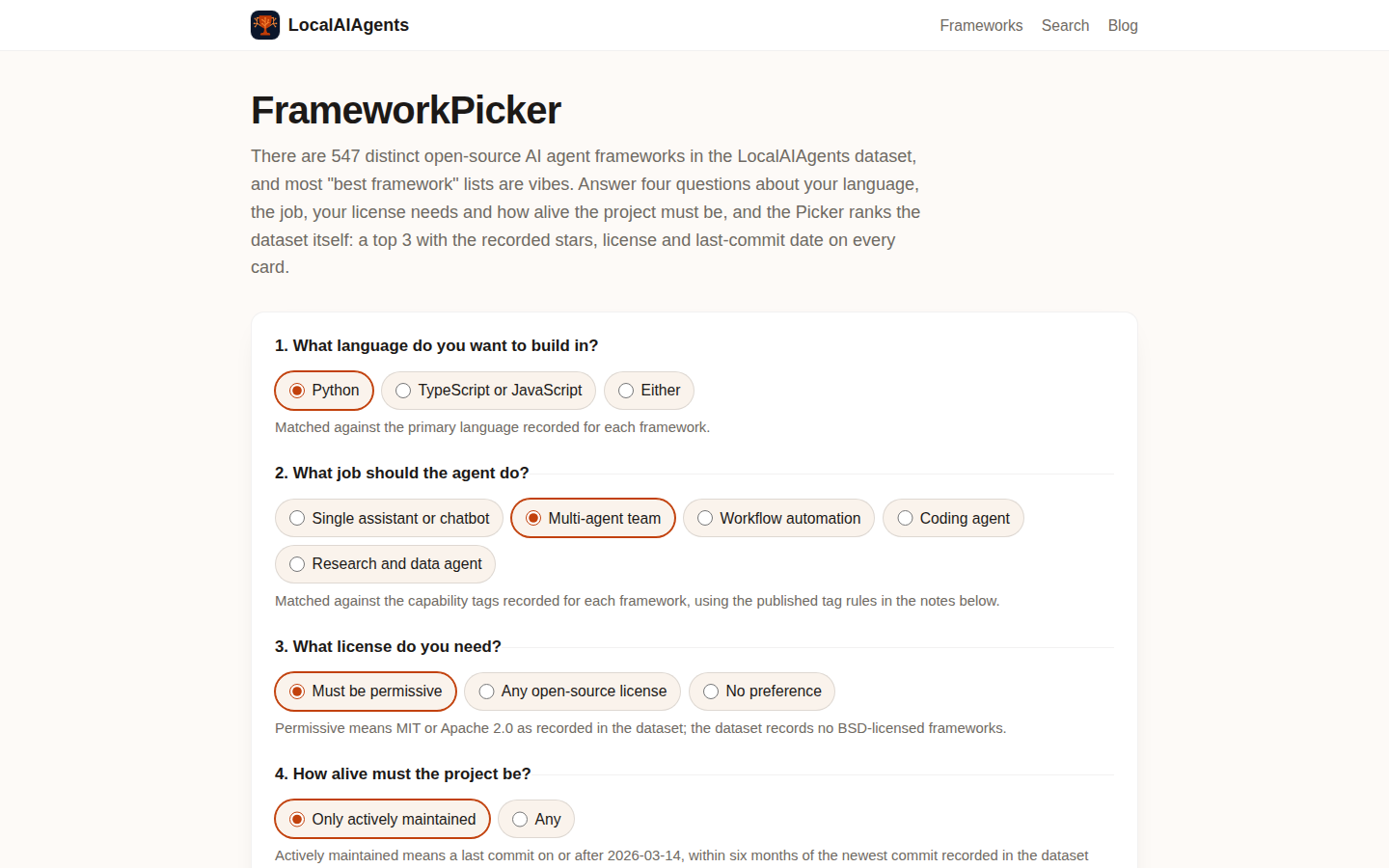
If the license must be permissive, the choice is Langflow at scale or Botpress for chat. If scope matters more than license purity, Dify is the shelf's center of gravity. And if your real question is code versus no-code rather than which builder, the FrameworkPicker asks it directly, alongside language, license and hosting, over all 548 records. The commercial side of this category is covered in the no-code builder apps comparison.