
Guides to the agent tool stack usually sort tools into layers: a framework for the agent logic, infrastructure to run it, monitoring to watch it, deployment to ship it. This page keeps that shape and changes the evidence. Every pick below is an open-source project drawn from the LocalAIAgents dataset of 548 framework records (547 distinct projects, snapshot September 14, 2026), with its recorded GitHub stars, primary language and license. There are no sponsored placements and no hands-on claims: the ranking inside each layer is the dataset's own numbers.
Layer one: core agent logic
LangChain (146,312 stars, Python, MIT). The default starting point of the ecosystem, with the widest integration surface in the dataset. Best for: teams that want the framework with an answer to every integration question. AutoGen (60,981 stars, Python, recorded license CC BY 4.0). Microsoft's multi-agent conversation framework, the research community's reference implementation. Best for: multi-agent dialogue patterns. CrewAI (58,535 stars, Python, MIT). Role-based crews of agents with a gentler learning curve than the graph frameworks. Best for: business-process agents built by small teams. LangGraph (41,626 stars, Python, MIT). LangChain's graph runtime for stateful, controllable agents. Best for: production flows where the agent's path must be explicit. Mastra (28,033 stars, TypeScript, custom license terms as recorded). The TypeScript-native entry in a Python-heavy layer: 142 of the dataset's projects are TypeScript, and Mastra is its highest-profile framework. Best for: TypeScript shops.
Layer two: web and data access
Firecrawl (180,338 stars, TypeScript, AGPL-3.0). The dataset's most-starred project overall is not a framework at all but the web-extraction layer agents feed on, turning pages into clean markdown. Best for: agents that read the web. Note the AGPL license, the strongest copyleft in this list. Browser-Use (114,603 stars, Python, MIT). Browser automation driven by an LLM, the dataset's leader for agents that must click, type and navigate. Best for: web tasks with no API.
Layer three: coding agents
Gemini CLI (106,973 stars, TypeScript, Apache 2.0). Google's terminal agent, recorded here as a tool rather than a framework, which is how most developers actually meet this layer. Best for: terminal-first coding work. OpenHands (87,882 stars, TypeScript, MIT). The open software-development agent platform, the dataset's strongest entry for autonomous code work. Best for: teams evaluating an open coding agent.
Layer four: multi-agent and research systems
Deer Flow (82,429 stars, Python, MIT). ByteDance's deep-research harness, the layer's current momentum pick. Best for: research agents. MetaGPT (70,384 stars, Python, MIT). The multi-agent software-company simulation that defined its category, included with a warning the dataset makes visible: its maintenance flag is off and its last recorded commit is January 2026, so it is a study object, not a foundation. The maintenance census covers that pattern across all 547 projects.
How to choose from this stack
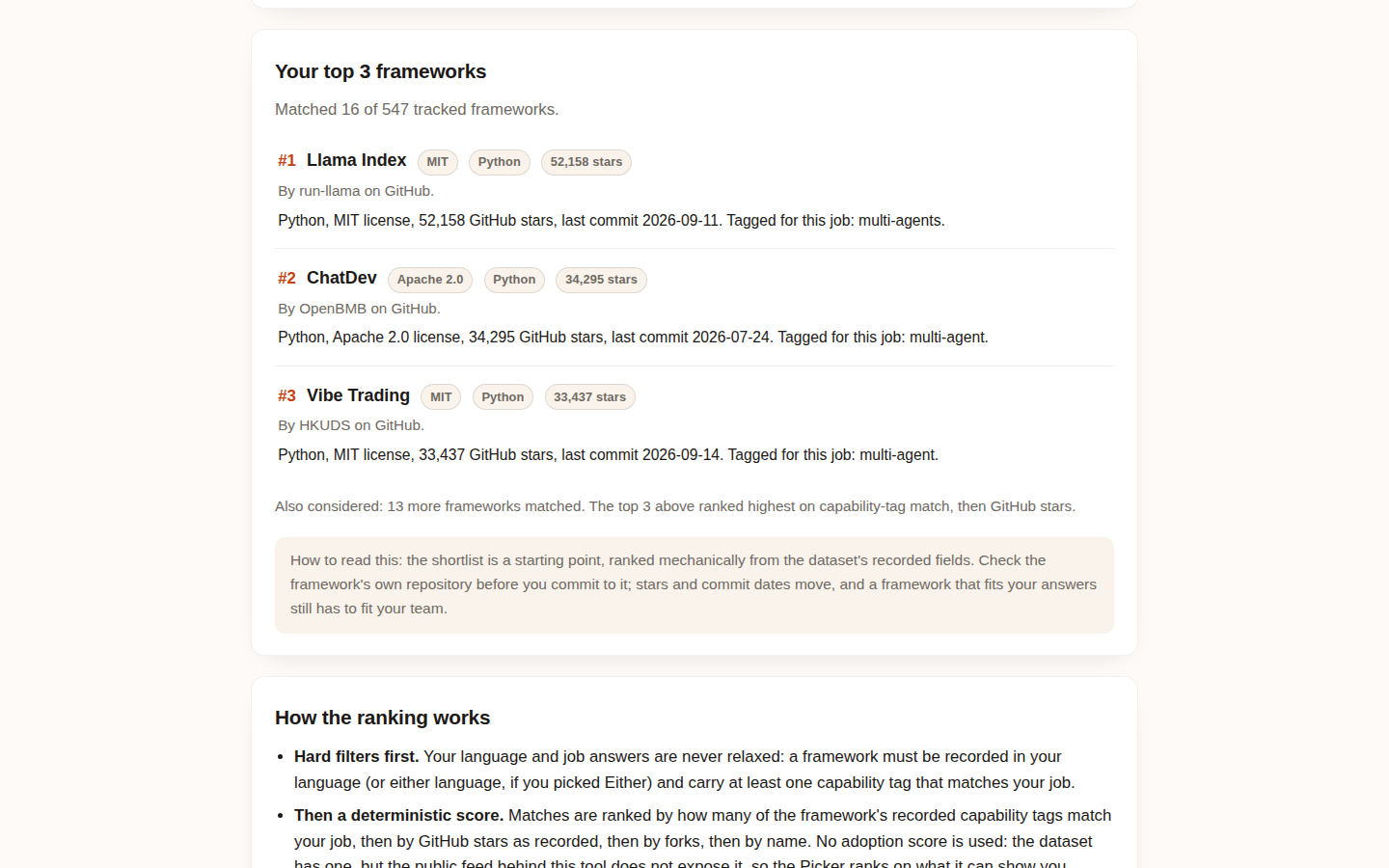
Start with the layer that is actually your bottleneck; most failed agent projects picked a framework before knowing whether their problem was logic, data access or supervision. Then apply the two filters the dataset makes cheap: license (256 of the 547 projects are MIT and 165 are Apache 2.0, so a permissive shortlist is never short) and maintenance (check the flag before the stars). The FrameworkPicker runs exactly that logic over all 548 records from your answers to four questions. For a second opinion on the framework layer alone, the open-source builder shelf covers the visual end, and what stars do and don't tell you is the necessary skepticism to bring to every number above.
Frequently asked questions
What tools do I need to build an AI agent? One framework from layer one, a way for the agent to reach data (layer two), and supervision you trust. The rest of the stack is added when scale demands it.
Are these tools free? Every pick is open source. The cost differences hide in the licenses: MIT and Apache 2.0 impose almost nothing, AGPL imposes copyleft on network use, and a few projects record custom terms. The companion piece prices that out: 8 AI agent tools that cost nothing, and what nothing costs.
Why is a scraping tool the most-starred entry? Because the dataset counts the whole agent toolchain, and agents are only as good as the data they can reach. It is also a reminder that star counts measure attention, not category.